
Old English Translator: Modern English to Anglo-Saxon
Translate modern English into real Old English, the Anglo-Saxon language of Beowulf, with thorn, eth and ash, or into Chaucer’s Middle English and playful Ye Olde medieval speech. Paste Old English to read it in modern words, type special letters with one tap, and learn 250+ Anglo-Saxon words.
- 3 periods of English
- 250+ Anglo-Saxon words
- ⇄ old ⇄ modern
- þ ð æ letter keyboard
Your words through the ages
Studying Beowulf or planning a medieval feast?
Share the Old English translator with your class or guild.
Old English, Middle English and Ye Olde Lines
Famous and everyday lines from three periods. Copy keeps one as written; Edit in tool sends its modern meaning to the box so every period can retell it.
What Is Old English?
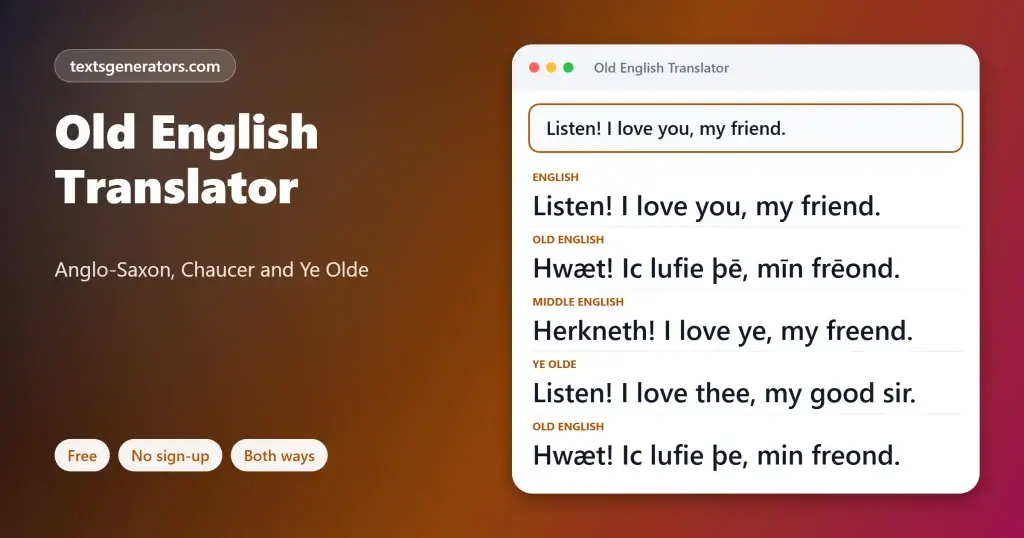
Quick answer: Old English, also called Anglo-Saxon, is the earliest form of English, spoken in England from about 450 to 1100. It looks almost foreign today: I love you, my friend is Ic lufie þē, mīn frēond, written with letters such as þ (thorn), ð (eth) and æ (ash) that modern English has lost.
Many people searching for an Old English translator want one of three different things: real Anglo-Saxon, the Middle English of Chaucer, or the mock-medieval Ye Olde style used for fairs and shop signs. This page does all three, and it keeps Shakespeare’s thee and thou for the separate Shakespeare translator.
In Old English mode, the translator uses West Saxon spellings, the best-documented dialect, with long-vowel marks you can switch off. Common verbs get their proper forms, so I love becomes ic lufie rather than a dictionary entry, and phrases such as how are you become hū eart þū. Translate back, and the tool accepts text with or without accents, so ic lufie þe is understood as well as ic lufie þē.
- 250+ Anglo-Saxon words
- 3 Periods: Old, Middle, Ye Olde
- 450–1100 The Old English period
- 14 Special letters on the keyboard
Old English vs Middle English vs Shakespearean English
| Period | Dates | Famous text | “The king has a great sword.” |
| Old English | about 450–1100 | Beowulf | Se cyning hæfþ micel sweord. |
| Middle English | about 1100–1500 | The Canterbury Tales | The king hath a greet sword. |
| Early Modern English | about 1500–1700 | Shakespeare, King James Bible | The king hath a great sword. |
| Ye Olde (modern fun) | today | Fairs, signs, role-play | Hark! Ye king has a great sword. |
The Norman Conquest of 1066 brought thousands of French words into English and wore away Old English word endings, which is why Chaucer is readable with practice while Beowulf needs a translation. Looking for thee, thou, and thy rather than Anglo-Saxon? The Shakespeare translator covers Early Modern English.
Old English Letters: Thorn, Eth, Ash and Wynn
| Letter | Name | Sound | Example |
| þ Þ | thorn | th, as in thin or this | þū (you) |
| ð Ð | eth | th, used interchangeably with thorn | ðæt (that) |
| æ Æ | ash | a as in cat | dæg (day) |
| ƿ | wynn | w | ƿīf (woman), usually printed as w today |
| ā ē ī ō ū ȳ | long vowels | held longer, marked by modern editors | hām (home) |
Use the Old English Letters panel to type them. C before e or i usually sounded like ch (cild, child), and sc sounded like sh (scip, ship). To write in blackletter lettering, the style many call Old English font, use the Old English font generator.
Why Is It “Ye Olde”? The Thorn Mistake
Nobody in the Middle Ages said “ye” for the. Scribes wrote the as þe, with a thorn, and in later handwriting and early printing the thorn looked very like a y. Printers without a thorn letter used y instead, so þe was printed ye but still pronounced the. Centuries later, sign-makers read it literally, and Ye Olde Tea Shoppe was born. The medieval mode keeps that joke alive for fun.
Old English Words We Still Use
| Old English | Meaning then | Modern word |
| wyrd | fate | weird |
| hlāf | bread | loaf |
| hlāford | loaf-keeper, lord | lord |
| mōd | mind, courage | mood |
| cēne | brave | keen |
| hund | dog | hound |
| fugol | bird | fowl |
| cniht | boy, servant | knight |
Most of the hundred commonest words in English today, such as the, and, be, have, man, day and water, come straight from Old English. Writing Anglo-Saxon names in runes for a story? Try the rune options in the fantasy font generator.
How to Translate Old English to Modern English
- Paste the Old English: With or without long-vowel marks; ð and þ are both accepted.
- Choose Old English → Modern English: The tool also offers this when it spots þ, ð, or æ.
- Read the gloss: Each known word becomes its modern meaning, phrase by phrase.
- Check the dictionary: Look up unchanged words; endings vary, so search the root.
Old English changes word endings for case, number, and gender, so the translator works as a glossary for common forms rather than a full grammar engine. For coursework, compare with a scholarly edition. For an even older script, see your name in Egyptian signs with the hieroglyphics translator.
Which Old English greeting means hello?
Wes hāl, meaning be well or be healthy. It also gave us the word wassail.
What is I love you in Old English?
Ic lufie þē.
What does hwæt mean?
Hwæt is the first word of Beowulf, usually translated as Listen!, Lo! or So. Elsewhere, it means what?
Is Old English the same as Shakespearean English?
No. Shakespeare wrote Early Modern English around 1600. Old English is about a thousand years older and needs translation; use the Shakespeare translator for thee and thou.
What are þ and ð?
Thorn (þ) and eth (ð) both stood for the th sound. Scribes used them interchangeably.
Why does Ye Olde use a y?
In Ye Olde, ye is a printed form of þe, where the thorn looked like a y. It was always pronounced the.
What is Middle English?
English from about 1100 to 1500, after the Norman Conquest, the language of Chaucer’s Canterbury Tales.
Can this translate Old English to modern English?
Yes. Pick Old English → Modern English. Accents and the ð or þ spelling are optional.
How accurate is the Old English translation?
Common words and verb forms are correct West Saxon. Full Old English grammar changes endings by case and gender, so treat longer results as a guided gloss.
What is Anglo-Saxon?
Another name for Old English, after the Angles and Saxons who settled in Britain from the 5th century.
What was the first word of Beowulf?
Hwæt, followed by Wē Gār-Dena in gēar-dagum, of the Spear-Danes in days of yore.
What does wyrd mean?
Fate or destiny. It is the ancestor of the modern word weird.
How do you say king in Old English?
Cyning, pronounced roughly KÜ-ning.
How do you say friend in Old English?
Frēond. Its opposite, fēond, meant enemy and became fiend.
Did Old English have the word a?
No. Old English had no indefinite article, so the translator leaves a and an out.
How do I type Old English letters?
Open the Old English Letters panel and tap þ, ð, æ, ƿ, or a long vowel to insert it.
What is the Chaucer mode?
It rewrites your text with Middle English spellings and words such as ful (very), eek (also), and seyde (said).
Can I use Old English words for a tattoo?
The dictionary uses standard West Saxon forms, but always have a scholar check a tattoo, because spellings and endings vary.
What is medieval knight speak?
A modern, playful style for fairs and games, with hail, huzzah, m’lady, and ye for the. It is not historical speech.
Do I pay or sign up to use it?
Neither. All three periods, the keyboard and the dictionary are free to use.
Is the text I enter stored?
No. The page works it out locally and keeps nothing.
Translate Into the English of Beowulf
📜 Wes hāl
Anglo-Saxon, Chaucer, and Ye Olde, both ways and free. 📜 Start Translating
- Alien Language Translator: English to Alien Text
- Braille Translator: English to Braille and Braille to English
- British Slang Translator: American to British English
- Cat Translator: Human to Cat and Meow to English
- Caveman Translator: English to Ooga Booga
- Dog Translator: Human to Dog and Dog to Human
- Dragon Language Translator: English to Dovahzul
- Dumb It Down Translator: Complicated Text to Plain English
- Elvish Translator: English to Sindarin and Quenya
- Fancy English Translator: Make Your Words Sound Posh
- Fun Translator: 24 Silly, Secret and Fictional Languages
- Gen Z Slang Translator and Dictionary
- High Valyrian Translator: Game of Thrones Language
- Jamaican Patois Translator: English to Patwa and Back
- Minion Translator: English to Minionese
- Na’vi Translator: Talk Like the People of Pandora
- NATO Phonetic Alphabet Translator: Alfa, Bravo, Charlie
- Parseltongue Translator: Speak the Language of Snakes
- Pig Latin Translator: English to Pig Latin and Back
- Pirate Translator: English to Pirate Speak
- Scottish Translator: English to Scots and Back
- Toki Pona Translator: English to the Language of Good
- Victorian English Translator: Speak Like the 1800s
- Yoda Translator: Talk Like Yoda You Will
No tools match your search. Try another word or choose "All tools".