
Caesar Cipher and Secret Code Translator VHFUHW
Encode and decode the Caesar cipher with any shift, and let the cracker try all 25 shifts and pick the English answer for you. Beyond Caesar, this secret code translator covers ROT13, Atbash, Vigenère, rail fence, Bacon, Polybius, tap code and phone keypad codes in both directions, and draws pigpen messages and cipher wheels as images.
- A ⇄ D Caesar with any shift
- 🔓 automatic code cracker
- 13 classic ciphers both ways
- 20+ ready-made secret codes
| Shift | Decoded text | English score |
|---|
Your message in secret codes
Planning a treasure hunt or an escape room?
Send the secret code translator to your fellow puzzle makers.
Coded Messages in Caesar, ROT13 and Atbash
Short messages already encrypted. Copy grabs the code; Edit in tool loads it in the main box, where one of the cards will show the answer.
What Is a Caesar Cipher?
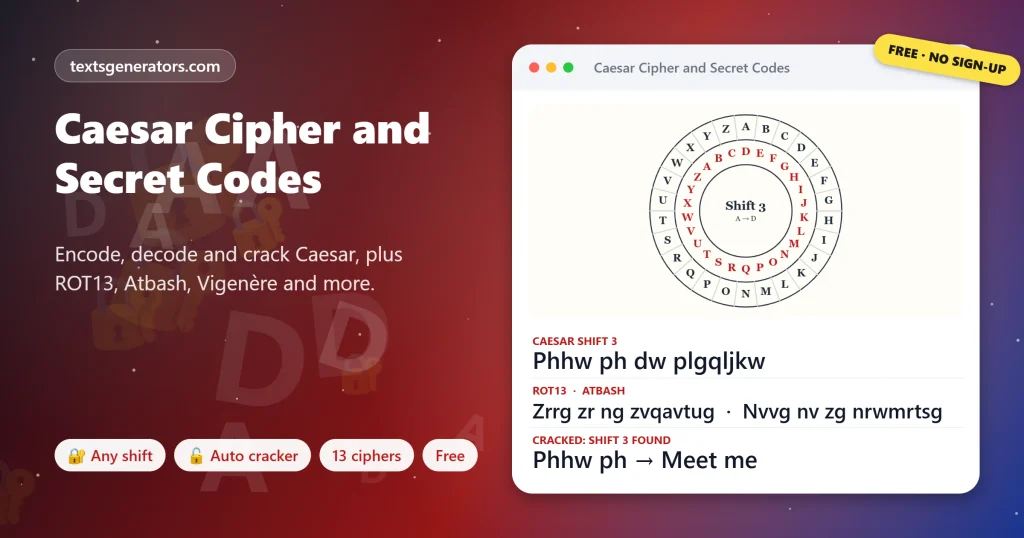
Quick answer: the Caesar cipher hides a message by shifting every letter a fixed number of places along the alphabet. With a shift of 3, A becomes D, B becomes E, and HELLO becomes KHOOR. To decode, shift back by the same number. It is named after Julius Caesar, who used a shift of three according to the Roman historian Suetonius.
The Caesar cipher is the starting point of cryptography lessons everywhere because it is simple enough to do by hand yet shows every key idea: a plain message, a secret key, an encrypted message, and the art of breaking it.
This page encodes and decodes Caesar with any shift from 1 to 25 and includes a cracker: it tries every shift, scores each result against normal English letter frequencies, and highlights the one that reads like English. A workbench adds thirteen more classic ciphers, from ROT13 and Atbash to Vigenère, rail fence, Bacon, Polybius, tap code, and the phone keypad, each working in both directions. You can also draw a message in pigpen symbols or print a Caesar wheel set to your chosen shift.
- 25 Caesar shifts tested at once
- 13 Ciphers in the workbench
- 2 Printable cipher images
How Do You Decode a Caesar Cipher?
- Paste the coded message: Keep spaces and punctuation; only letters are shifted.
- Try the shift you know: Set the slider to the key, often 3 for a classic Caesar.
- Or crack it: The cracker tests all 25 shifts and marks the most English-looking result.
- Copy the answer: Use the button beside any row to load that shift.
What Does a Shift of 3 Look Like?
| Plain | A | B | C | D | E | F | G | H | I | J | K | L | M |
| Shift 3 | D | E | F | G | H | I | J | K | L | M | N | O | P |
| Plain | N | O | P | Q | R | S | T | U | V | W | X | Y | Z |
| Shift 3 | Q | R | S | T | U | V | W | X | Y | Z | A | B | C |
For the A1Z26 number code, where A is 1 and Z is 26, use our letters-to-numbers converter.
When the shift passes Z, it wraps around to the start, so X becomes A, Y becomes B, and Z becomes C.
Which Classic Ciphers Can You Use Here?
| Cipher | How it works | “attack” becomes | Difficulty to break |
| ROT13 | Caesar with a shift of 13; the same step decodes | nggnpx | Trivial |
| Atbash | The alphabet folded in half: A↔Z, B↔Y | zggzxp | Trivial |
| Vigenère | A keyword sets a different shift for each letter | Depends on the key | Moderate |
| Rail fence | Letters zigzag across rails, then are read row by row | ATCTAK (2 rails) | Easy |
| Bacon | Each letter becomes five A or B symbols | AAAAA BAABB … | Easy once spotted |
| Polybius | Each letter becomes a row and column number | 11 44 44 11 13 25 | Easy |
How Does the Code Cracker Work?
A Caesar cipher has only 25 possible keys, so a computer can simply try them all; this is called a brute-force attack. To pick the right answer without reading every line, the cracker uses frequency analysis, the technique described by the Arab scholar al-Kindi in the 9th century. English text uses E, T, A, and O far more than J, Q, X, or Z, so the shift whose letter counts best match normal English is almost always the real message. Very short messages can fool it, which is why the full list stays visible.
Keyed ciphers resist this longer. The Vigenère cipher, described by Giovan Battista Bellaso in 1553 and later named after Blaise de Vigenère, was called “the indecipherable cipher” for three centuries until codebreakers learned to find the key length first.
Minecraft fans can hide clues in the galactic alphabet with the enchanting table translator.
Where Are Secret Codes Used for Fun?
- Escape rooms and treasure hunts: clues locked behind a shift or a pigpen drawing.
- Geocaching: hints commonly hidden with ROT13 on cache pages.
- Classrooms and code clubs: hands-on lessons in maths, history and computing.
- Online forums: ROT13 to hide spoilers and puzzle answers.
- CTF competitions: warm-up challenges built on classic ciphers.
- Notes between friends: playful messages only your group can read.
Want a computer-style code instead? Turn messages into 0s and 1s with the binary translator.
Cryptography Terms
Plaintext
The original, readable message before it is encoded.
Ciphertext
The scrambled message produced by a cipher.
Key
The secret setting, such as a shift number or a keyword, needed to decode.
Substitution cipher
A cipher that replaces each letter with another, like Caesar or Atbash.
Transposition cipher
A cipher that keeps the letters but changes their order, like the rail fence.
Frequency analysis
Breaking codes by comparing letter counts with those of the original language.
Everything in This Secret Code Translator
Caesar both ways
Any shift, optional digit rotation.
Automatic cracker
All 25 shifts ranked by English score.
Keyed ciphers
Vigenère, Beaufort, and affine with your keys.
Transpositions
Rail fence and columnar, encode and decode.
Symbol codes
Bacon, Polybius, tap code, and keypad.
Printable images
Pigpen messages and cipher wheels.
Found a coded message and no key?
Paste it into the cracker and let it test every Caesar shift.
Why Won’t My Message Decode?
| What happens | Likely reason | Try this |
| No shift gives English | It is not a Caesar cipher | Try Atbash, Vigenère, or a transposition in the workbench |
| The cracker picks a wrong shift | The message is very short | Read the whole list; short words skew letter counts |
| Vigenère output is gibberish | The key word is wrong or misspelled | Check the key, and make sure the mode is Decode |
| Rail fence decodes into a jumble | The number of rails differs | Try 2, 3, 4, and 5 rails |
| Bacon decodes to question marks | A group has fewer than five letters | Count each group of A and B carefully |
Hacker-style number swaps live on our leetspeak translator.
Tips for Making Good Puzzle Codes
Give a hint about the method
A picture of Caesar or a wheel tells players where to start.
Hide the key nearby
A number on a clock or a word on a poster makes a satisfying key.
Layer two ciphers
Atbash and then ROT13 stop quick guessers.
Never use these for real secrets
Classic ciphers are puzzles, not security; use modern encryption for private data.
For a symbol alphabet that looks like a code, try the Wingdings translator.
Caesar Cipher and Secret Code FAQ
What is a Caesar cipher?
A code that shifts each letter a set number of places in the alphabet, such as A to D with a shift of 3.
How do I decode a Caesar cipher?
Shift every letter back by the same number, or paste the message into the cracker to test all 25 shifts.
What shift did Julius Caesar use?
Three, according to the historian Suetonius, so A became D.
Can this tool crack a Caesar cipher without the key?
Yes. It tries every shift and ranks the results by how closely their letters match English.
What is ROT13?
A Caesar cipher with a shift of 13. Because the alphabet has 26 letters, applying it twice gives the original text.
What is the Atbash cipher?
An old substitution that reverses the alphabet, so A becomes Z and B becomes Y. It began with the Hebrew alphabet.
How does the Vigenère cipher work?
A keyword decides the shift for each letter in turn, so the same letter can be encoded differently each time.
What is a rail fence cipher?
A transposition that writes the message in a zigzag across rails and reads it off row by row.
What is the Bacon cipher?
Francis Bacon’s code that turns each letter into five A or B symbols, which can be hidden in text styles.
What is the Polybius square?
A 5 × 5 grid of letters where each letter is written as its row and column numbers.
What is tap code?
A knocking code based on a letter grid, used by prisoners to communicate through walls.
How does the phone keypad code work?
Old mobile phones needed several presses per letter, so C, the third letter on key 2, is written 222.
Can I make a pigpen cipher message?
Yes. Type a message in the image panel and download it drawn in pigpen symbols.
What is a Caesar cipher wheel?
Two rings of letters; turning the inner ring sets the shift. Download one set to any shift and print it.
Is the Caesar cipher secure?
No. With only 25 possible keys, it can be broken in seconds, so use it for games and lessons only.
Does the cipher change numbers and punctuation?
Letters only, unless you tick Also shift digits. ROT47 changes digits and symbols too.
Why does the cracker sometimes choose wrong?
Short messages have too few letters for reliable statistics; check the other high-scoring rows.
What is the keypad style code?
Another name for the phone keypad or multi-tap code used on old mobile phones.
Is this secret code translator free?
Yes. Encoding, decoding, cracking, and the images are free to use.
Is my message sent anywhere?
No. All ciphers run locally in your browser.
Can I use these codes in a classroom?
Yes. Teachers use the Caesar cracker and pigpen images for maths, history, and computing lessons.
Encode, Decode and Crack Secret Codes
Vhfuhw Frgh
Caesar with any shift, a code cracker, and 13 classic ciphers. 🔐 Start Encoding
- 3D Text Generator
- Aesthetic Text Generator
- Arrow Text Generator
- Big Text Generator
- Birthday Text Generator
- Bold Italic Text Generator
- Bold Text Generator
- Bracket and Boxed Text Generator
- Bubble Text Generator
- Calligraphy Text Generator
- Christmas Text Generator
- Clap Emoji Text Generator
- Cool Fonts Generator
- Copy and Paste Fonts
- Cursive Generator: Cursive Letters and Fonts
- Cute Fonts Generator
- Cybersigilism Text Generator
- Decorative Text Generator
- Discord Fonts Generator
- Diwali Text Generator
- Double Struck Text Generator
- Drunk Text Generator
- Eid Text Generator
- Emoji Text Generator
- Fancy Text Generator
- Flag Text Generator
- Glitch Text Generator: Zalgo and Cursed Text
- Glow Text Generator
- Gothic Text Generator
- Halloween Text Generator
- Heart Text Generator
- Invisible Text Generator
- Italic Text Generator
- LinkedIn Text Generator
- Love Text Generator
- Minecraft Color Codes and Colored Text Generator
- Monospace Text Generator
- Neon Text Generator
- New Year Text Generator
- Old English Font Generator and Translator
- Redacted Text Generator: Black Out Words
- Serif And Sans Serif Text Generator
- Small Caps Generator
- Small Text Generator
- SpongeBob Mocking Text Generator
- Square Text Generator
- Star Text Generator
- Strikethrough Text Generator
- Stylish Text Generator
- Subscript Text Generator
- Underline Text Generator
- Valentine’s Text Generator
- Vaporwave Text Generator
- Weird Text Generator
No tools match your search. Try another word or choose "All tools".