
Hieroglyphics Translator: English to Egyptian Hieroglyphs 𓍹𓂋𓄿𓍺
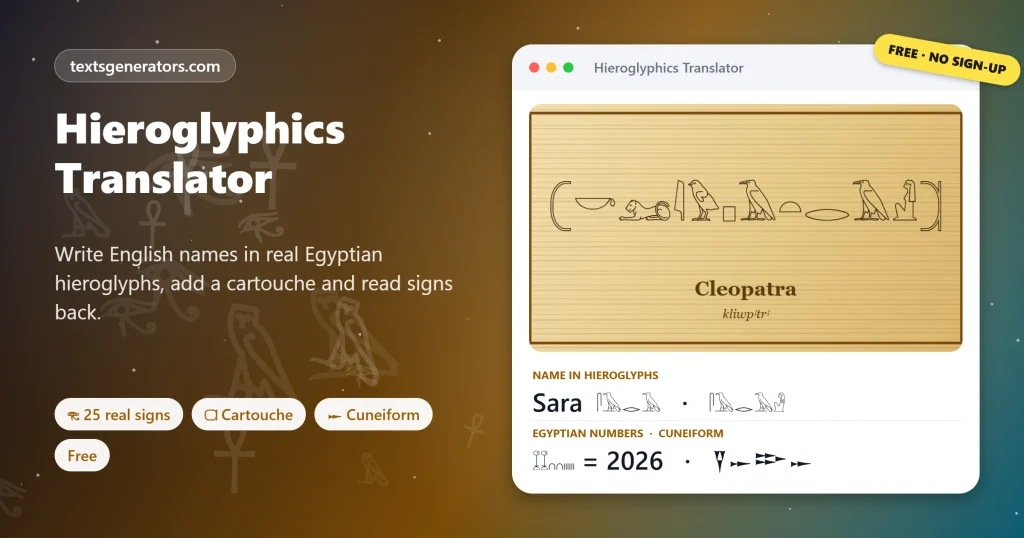
This hieroglyphics translator writes English names and words in Egyptian hieroglyphs using the real one-sound signs scribes used, with an optional royal cartouche, a man or woman determinative and Egyptian numerals. Read hieroglyphs back with the sign chart, save your cartouche as a papyrus image, and try the Ugaritic cuneiform alphabet too.
- 25 real uniliteral signs with Gardiner codes
- 𓍹𓍺 royal cartouche maker
- PNG papyrus image download
- 20+ hieroglyph and cuneiform styles
Signs appear on Windows 10 and 11, Android and newer Apple devices, and the page fetches a free Egyptian font so this preview renders elsewhere too.
Your name in hieroglyphs and cuneiform
Know someone who loves ancient Egypt?
Send them the hieroglyphics translator.
Hieroglyph Names, Words and Bios to Copy
Famous names and everyday words already written in signs. Copy grabs the hieroglyphs; Edit in tool turns them back into Latin sounds for you to adjust.
What Is a Hieroglyphics Translator?
Quick answer: a hieroglyphics translator writes English names and words in Egyptian hieroglyphs by matching each sound to one of the roughly 25 uniliteral signs, such as the owl 𓅓 for M and the mouth 𓂋 for R. It spells sounds rather than translating grammar, which is also how ancient scribes wrote foreign names like Cleopatra.
Egyptian hieroglyphs were used for more than 3,000 years, from about 3200 BC until the last known inscription at the temple of Philae in AD 394. The script mixed three kinds of signs: one-sound signs, signs for groups of sounds, and silent picture signs that showed what a word meant.
Every sign it outputs comes from the Egyptian Hieroglyphs range of Unicode, which means you copy genuine characters rather than an image. It shows a key for every sign with its sound, its object, and its Gardiner code, wraps names in a cartouche, adds a man or woman determinative, writes numbers with Egyptian numerals, and saves the result as a papyrus image. A sign chart lets you read hieroglyphs back, and a second translator covers the Ugaritic cuneiform alphabet.
- 25 One-sound signs in the chart
- 7 Egyptian number signs
- 30 Ugaritic cuneiform letters
How Do You Translate English to Hieroglyphs?
- Type a name or a word: Short names work best, just as in real royal inscriptions.
- Choose a frame: A cartouche marks a royal name; leave it off for ordinary words.
- Add a determinative: A seated man or woman after the name shows who it belongs to.
- Copy or save: Copy the signs as text, or download a papyrus image for printing.
Which Hieroglyph Stands for Each Letter?
| Letter | Sign | Object | Gardiner code |
| A | 𓄿 | Egyptian vulture | G1 |
| B | 𓃀 | Foot | D58 |
| C, K | 𓎡 | Basket with handle | V31 |
| D | 𓂧 | Hand | D46 |
| E, I | 𓇋 | Flowering reed | M17 |
| F, V | 𓆑 | Horned viper | I9 |
| G | 𓎼 | Jar stand | W11 |
| H | 𓉔 | Reed shelter | O4 |
| J | 𓆓 | Cobra | I10 |
| L | 𓃭 | Recumbent lion | E23 |
| M | 𓅓 | Owl | G17 |
| N | 𓈖 | Ripple of water | N35 |
| O, U, W | 𓅱 | Quail chick | G43 |
| P | 𓊪 | Stool | Q3 |
| Q | 𓈎 | Sandy hill slope | N29 |
| R | 𓂋 | Mouth | D21 |
| S | 𓋴 | Folded cloth | S29 |
| SH | 𓈙 | Pool | N37 |
| T | 𓏏 | Bread loaf | X1 |
| CH, TH | 𓎿 | Tethering rope | V13 |
| KH | 𓐍 | Placenta | Aa1 |
| Y | 𓇌 | Two reeds | M17a |
| Z | 𓊃 | Door bolt | O34 |
Prefer a modern picture alphabet? The Wingdings translator swaps letters for computer symbols.
Gardiner codes come from the sign list Alan Gardiner published in his Egyptian Grammar in 1927; Egyptologists still use them to name each hieroglyph.
Can English Really Be Translated into Hieroglyphs?
Not word for word. Egyptian had its own vocabulary and grammar, and the Middle Egyptian of classic inscriptions differs as much from English as Chinese does. What any online hieroglyphics translator can do, honestly, is transcribe sounds, the method scribes used for foreign rulers: the Greek queen Cleopatra and the Roman emperors appear in temple walls spelled out with one-sound signs inside cartouches.
Vowels are the other catch. Egyptian writing recorded consonants and weak sounds, so letters like A, E, and O are approximations, and two books may spell the same modern name slightly differently. Both can be right.
How Did Ancient Egyptians Write Numbers?
Egyptian numbers repeated a sign for each power of ten: a stroke 𓏺 for one, a cattle hobble 𓎆 for ten, a coil of rope 𓍢 for a hundred, a lotus 𓆼 for a thousand, a finger 𓂭 for ten thousand, a tadpole 𓆐 for a hundred thousand, and a kneeling god 𓁨 for a million. Type any number in the main box and the Egyptian Numbers style writes it this way, so 2026 becomes two lotus flowers, two hobbles and six strokes.
What Is the Cuneiform Translator?
Cuneiform is the wedge-shaped writing pressed into clay in Mesopotamia. Most cuneiform used hundreds of syllable signs, but the city of Ugarit on the Syrian coast created a compact alphabet of 30 letters in the 14th century BC. The cuneiform translator maps English letters to that alphabet, adds the small vertical wedge Ugaritic scribes used between words if you ask for it, and reads Ugaritic letters back into Latin ones.
Who Uses Egyptian Hieroglyphs Today?
- Students and teachers: history lessons where pupils write their own names in signs.
- Gifts and crafts: cartouche names for pendants, cards, cakes and frames.
- Tattoos: a name or word previewed in hieroglyphs before visiting the artist.
- Escape rooms and puzzles: clues that players decode with the sign chart.
- Profiles and games: an Egyptian-themed name or bio line.
- Travellers: reading cartouches seen in museums and temples.
For runes, elvish script, and medieval lettering beside your Egyptian name, open the fantasy font generator.
Hieroglyph Terms Explained
Uniliteral sign
A hieroglyph that stands for one consonant, the closest thing Egyptian had to an alphabet.
Cartouche
The oval loop drawn around royal names, representing a knotted rope that encircles what the king ruled.
Determinative
A silent picture placed after a word to show its meaning, such as a seated man after a man’s name.
Gardiner code
A letter and number, like G17 for the owl, that identifies a sign in Gardiner’s list.
Rosetta Stone
A decree in hieroglyphs, Demotic and Greek, found in 1799, that Jean-François Champollion used to decipher hieroglyphs in 1822.
Transliteration
Writing Egyptian sounds with Latin letters and marks such as ꜣ, ḥ, and š, shown under every translation here.
What This Hieroglyphics Translator Offers
Sound-based translator
Real one-sound signs with a key.
Cartouche and titles
Royal ring, Son of Ra title, blessing.
Determinatives
Seated man or woman after names.
Egyptian numerals
Any number up to millions.
Reader and chart
Tap signs or paste text to read sounds.
Cuneiform
Ugaritic alphabet, both ways.
Other ancient scripts on this site include Anglo-Saxon runes in the Old English font generator.
Want your name on papyrus?
Write it in a cartouche and download a printable papyrus image.
Hieroglyphs Not Showing Correctly?
| Problem | Cause | Fix |
| Empty boxes instead of signs | The device has no Egyptian hieroglyph font | View on a current phone or computer, or share the papyrus image |
| The cartouche ends look separate | The font draws the ring as two halves | Use the papyrus image, which joins them neatly |
| A letter disappeared | Symbols and accented letters have no sign | Type the name with plain letters A to Z |
| A profile rejects the long name | Each sign counts as two characters | Use a short name or the Sound Spelling style |
| Cuneiform shows as squares | Ugaritic fonts are rarer than hieroglyph fonts | Copy into a document on Windows or Android |
Tips for Authentic-Looking Hieroglyphs
Spell by sound
Write Kleopatra with K, or Filip with F, for a closer Egyptian spelling.
Cartouches are for rulers
Ancient Egyptians reserved the ring for royal names; a fun exception is fine for gifts.
Add a determinative
A seated figure after a name looks far more like a real inscription.
Show the sounds
Put the transliteration under the signs so readers know what it says.
Need an ankh or an eye symbol on its own? Find it among our text symbols.
Hieroglyphics Translator FAQ
What is a hieroglyphics translator?
A tool that writes English sounds with Egyptian hieroglyphs, using the one-sound signs scribes used to spell names.
Is this hieroglyphics translator free?
Yes. Nothing on this page is paid, and you never need to register.
Can it translate whole English sentences?
It writes their sounds, not their meaning. Real translation would need Egyptian vocabulary and grammar, which no automatic tool does reliably.
How would my name look in hieroglyphs?
Enter it in the translator: every sound turns into its sign, then add a cartouche ring or a seated figure if you like.
What does a cartouche mean?
It marks a royal name. The oval stands for a looped rope, a symbol of everything the ruler governed.
Why are some vowels missing or different?
Egyptian recorded consonants and a few weak sounds, so vowels are approximations, and spellings can vary.
What is the hieroglyph for M?
The owl, sign G17. Type M, and the key shows it with its code.
How do I read hieroglyphs I already have?
Open the hieroglyph alphabet and reader, paste the signs, and their sounds appear in Latin letters.
Can I write numbers in hieroglyphs?
Yes. Digits become Egyptian numerals: strokes, hobbles, coils, lotus flowers, fingers, tadpoles, and the kneeling god.
What is a determinative?
A silent sign after a word that shows its meaning, such as a seated woman after a woman’s name.
Do these hieroglyphs work on Instagram and WhatsApp?
Yes, on most current phones. Older devices may show boxes, so a papyrus image is safer for printing or sharing.
Can I download my name as an image?
Yes. Press Save papyrus image to get a PNG with the signs, your name, and the sound spelling.
Is this suitable for a tattoo?
It is a good preview, but ask an Egyptologist or check museum examples before making it permanent.
What are Gardiner codes?
Labels such as G1 or D21 from Alan Gardiner’s 1927 sign list, used to identify every hieroglyph.
What was the Rosetta Stone?
A stone with the same decree in hieroglyphs, Demotic, and Greek; Champollion used it to crack hieroglyphs in 1822.
Can I translate English to cuneiform?
Yes. The cuneiform translator writes letters in the 30-letter Ugaritic alphabet and can read it back.
Is the cuneiform real?
Yes. Ugaritic letters are genuine Unicode characters from an alphabet used around 1400 to 1200 BC.
How many hieroglyphs are there?
Around 700 were common in classical times, and Unicode’s main block contains 1,071 signs.
Which direction should hieroglyphs face?
They could run left to right, right to left, or in columns. This translator writes left to right or in a column.
Is my text uploaded anywhere?
No. Translation, reading, and image making happen inside your browser.
Does it work on phones?
Yes. Copy the signs into any app, or save the papyrus image to your gallery.
Frame a hieroglyph name with wings and borders using the decorative text generator.
Translate Your Name into Hieroglyphs
𓍹𓂋𓄿𓍺
Real Egyptian signs, cartouches, numerals, and cuneiform. 𓂀 Start Translating