
Emoticons Copy and Paste, With Meanings
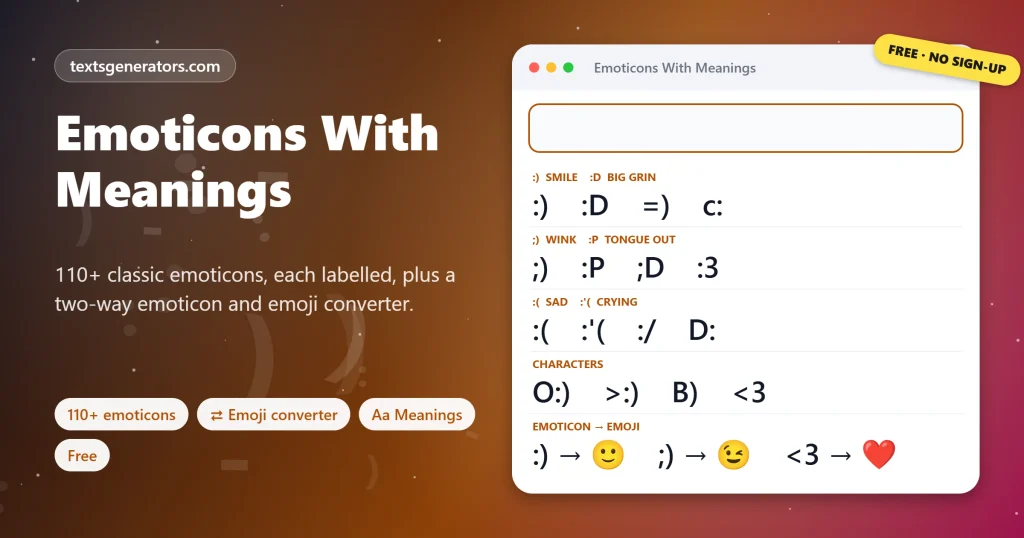
Every classic emoticon here comes with its meaning written underneath, and copying one costs a single tap. Every card is labelled with its meaning, from 🙂 and ;D to O:) and \o/, and the converter swaps emoticons for emoji (or back) across a whole message.
- 110+ emoticons
- Aa meaning on every card
- ⇄ emoticon to emoji converter
- 0 sign-ups
Emoticons and what they mean
Still sending 🙂 to a friend who only uses emoji?
Send them this page and the converter will translate either way.
Emoticon Replies for Texting, Work and Fun
Everyday lines ending in an emoticon. Copy takes the line; Edit in tool loads just its words so you can swap the ending.
What Is an Emoticon?
Quick answer: an emoticon, short for emotion icon, is a face or symbol made from keyboard punctuation, such as 🙂 for a smile or 🙁 for sadness. You read most of them by tilting your head to the left, so the colon becomes the eyes, and the bracket becomes the mouth.
Emoticons are the plain-text ancestors of emoji. They still matter in places that do not show pictures, and many people simply prefer their lighter, older feel.
Mix emoticons with upright faces in our text emojis collection.
Each card on this page names the emoticon’s meaning, so you never send ;P when you meant :P. The groups cover happy and playful faces, sad and unsure ones, surprise, anger, love, characters like the angel O:) and the devil >:), small action figures such as \o/, and upright ASCII faces like ^_^ that sit between emoticons and kaomoji.
- 8 Groups
- 2 Conversion directions
- 1982: the year the smiley was proposed
How to Copy Emoticons From This Page
- Scan the labels: Every card says what the emoticon means.
- Filter or search: Narrow the list by group, or look up a feeling (wink) or a symbol (:P).
- Tap the face: It is copied instantly, with your sentence if you typed one.
- Convert if needed: The converter swaps a whole message to emoji, or emoji back to emoticons.
How Do You Read a Sideways Emoticon?
Turn your head 90 degrees to the left. In 🙂 the colon is a pair of eyes, the hyphen is a nose, and the bracket is a smiling mouth. Swap one character and the feeling changes: a semicolon winks, a capital D opens the mouth in a grin, and a P sticks out a tongue. Characters placed before the eyes add hair, hats, or eyebrows, which is how O:) becomes an angel with a halo and >:) a scheming devil.
| Part | Common characters | Effect |
| Eyes | :; = 8 B X | Normal, winking, wide, glasses, sunglasses, squeezed shut |
| Nose | – ^ o | Optional; adds an old-fashioned or comic look |
| Mouth | ) ( D P O / | * | Smile, frown, grin, tongue, gasp, unsure, flat, kiss |
| Extras | ‘ > O 3 | Tears, angry brows, halo, horns |
Emoticon Meanings: The Ones People Ask About Most
| Emoticon | Meaning | Closest emoji |
| 🙂 | Smile, friendly | 🙂 |
| 😀 | Big grin, very happy | 😃 |
| 😉 | Wink, joking or flirting | 😉 |
| 😛 | Tongue out, teasing | 😛 |
| 🙁 | Sad or disappointed | 🙁 |
| :'( | Crying | 😢 |
| :O | Surprised | 😮 |
| :/ | Unsure, skeptical | 😕 |
| XD | Laughing hard | 😆 |
| :3 | Cute, cat-like | 😺 |
| B) | Cool, wearing sunglasses | 😎 |
| O:) | Innocent angel | 😇 |
Who Invented the Emoticon?
On 19 September 1982, Scott Fahlman posted to an online message board at Carnegie Mellon University and suggested marking jokes with 🙂 and serious posts with :-(. The idea spread to other universities within months. Typographic faces existed earlier in print, but Fahlman’s post is the moment the sideways smiley became a habit of online writing. Upright Japanese emoticons followed a few years later, and picture emoji arrived on Japanese phones in the late 1990s.
Upright Japanese faces such as (^▽^) are gathered on the kaomoji page.
Why Do Some Apps Turn Emoticons Into Emoji?
Messaging apps such as Microsoft Teams, Outlook, Skype, and some phone keyboards automatically replace a typed 🙂 with a picture. That helps casual chat but annoys people who want the original characters. To keep an emoticon as text, add a space inside it, undo the change straight after it happens, switch off the app’s emoji auto-replace setting, or send an upright face such as (^_^), which those apps leave alone.
The converter on this page works in both directions on purpose: emoticon to emoji for apps that look better with pictures, and emoji to emoticon for plain-text places such as code, command lines, SMS on old handsets, and accessibility-friendly documents.
If you want emoji placed between your words, try the emoji text generator.
What Are ASCII Emojis?
ASCII is the original 128-character set of English letters, digits, and punctuation. An ASCII emoji uses only those characters, so it works on any system ever built: :-), ^_^, \o/ and >_< all qualify. Faces with symbols like ツ, ಠ, or ᴥ are Unicode faces instead, and need fonts that include them. When maximum compatibility matters, stick to the cards in the Happy, Sad, Surprised, Angry, and Upright ASCII groups.
How to Use Emoticons Without Being Misread
Know the wink
😉 can read as flirting. In professional messages, a plain 🙂 is safer.
Watch the nose
🙂 feels a little older than :), which younger readers may notice.
Separate it with a space
Glued to a word, an emoticon can break a link or confuse auto-formatting.
Use one, not three
:):):) dilutes the effect; a single well-chosen face says more.
Emoticons FAQ
What does emoticon stand for?
It blends emotion and icon: a small symbol that shows how the writer feels.
What is the difference between an emoticon and an emoji?
An emoticon is built from punctuation, like :), while an emoji is a single picture character such as 🙂 that each phone maker draws in its own style.
Who made the first emoticon?
Scott Fahlman of Carnegie Mellon University proposed 🙂 and 🙁 on 19 September 1982.
Why are emoticons sideways?
Early computer screens only showed text in rows, so faces were drawn along the line and read by tilting the head.
What does 😛 mean?
A tongue sticking out: teasing, joking, or being silly.
What does XD mean?
Laughing so hard the eyes squeeze shut; the X is the closed eyes and the D is the open mouth.
What does :3 mean?
A cat-like smile that suggests cuteness or mischief.
What does O:) mean?
An angel with a halo, claiming innocence, often with a wink of irony.
What does >:) mean?
A grin with angry eyebrows: evil, scheming, or up to something.
What does \o/ mean?
A tiny figure throwing both arms up to celebrate.
What does :/ mean?
Unsure, unconvinced, or mildly disappointed.
How do I stop Outlook or Teams turning 🙂 into an emoji?
Undo with Ctrl+Z right after it changes, or turn off automatic emoticon replacement in the app settings.
How do I convert emoticons to emoji?
Paste your text into the Emoticon and Emoji Converter with 🙂 to emoji selected. Each standalone emoticon is swapped.
Can I turn emoji back into emoticons?
Yes. Switch the converter to Emoji to 🙂 and pictures with a known match become punctuation faces.
Will the converter break my links?
No. It only replaces emoticons separated by spaces or punctuation, so text like http:// is left as it is.
Are emoticons still used today?
Yes, in work chat, gaming, programming communities, and anywhere plain text is preferred.
Which emoticons work everywhere?
Pure ASCII ones such as 🙂 🙁 😉 😀 ^_^ and \o/, because they use only basic keyboard characters.
What is an upright emoticon?
A face read without tilting your head, like ^_^. The Japanese style built on this idea is called kaomoji.
How many emoticons are on this page?
More than 110, each with a written meaning and its closest emoji.
Can I add words before an emoticon?
Yes. Whatever sentence sits in the box up top appears on each card, closed off by the emoticon on that card.
Is this emoticon tool free?
Yes. Nothing to install, no account, and your starred emoticons stay in your browser.
Pick an Emoticon
🙂 ;D O:)
Classic keyboard faces with their meanings; one tap to copy. -) Copy Emoticons
- Kaomoji Copy and Paste: 1,200+ Japanese Emoticons
- Lenny Face Copy and Paste ( ͡° ͜ʖ ͡°)
- Shrug Emoticon ¯\_(ツ)_/¯ Copy and Paste
- Text Emojis: Copy and Paste Keyboard Faces
No tools match your search. Try another word or choose "All tools".