
camelCase Converter: Turn Words and Names Into camelCase
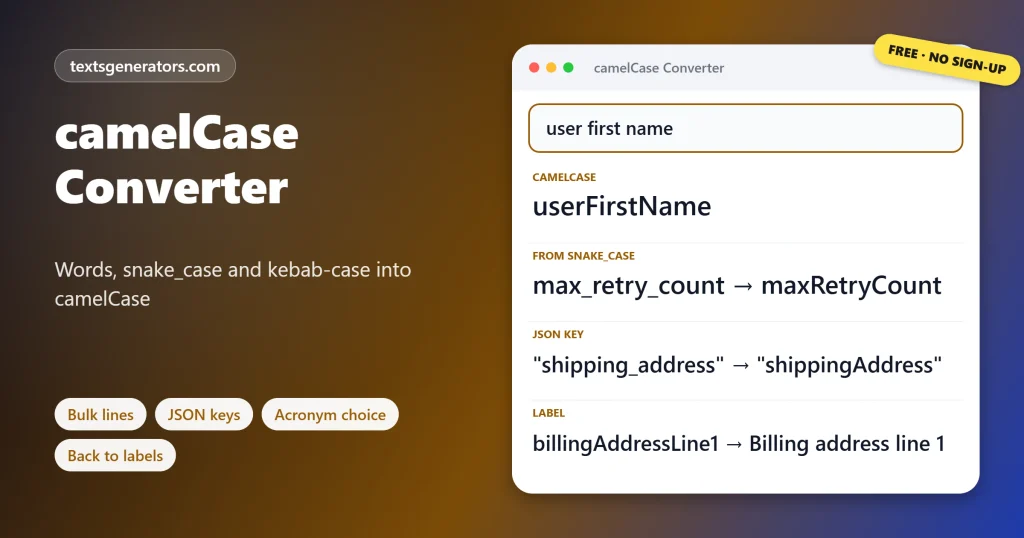
This free camelCase converter rewrites words, phrases, snake_case and kebab-case names as camelCase, one name per line, with no sign-up. It handles acronyms like HTTP your way, keeps every identifier valid, converts all the keys in a JSON object at once, and splits camelCase back into readable labels for forms and tables.
- cC bulk camelCase, one per line
- { } JSON key converter
- Aa camelCase to readable labels
- 7 output formats
Your names in camelCase and related formats
Renaming a whole API response?
Share this free camelCase converter with your team.
Variables, API Keys and Style Properties in camelCase
Common names already converted. Copy takes the camelCase name; Edit in tool restores the plain-words or snake_case source.
What Is camelCase?
Quick answer: camelCase is a way of joining several words into one name with no spaces: the first word is all lowercase and every following word begins with a capital, so user first name becomes userFirstName. The capitals in the middle stick up like the humps of a camel, which is where the name comes from.
It is also called lower camel case or dromedary case; the variant that capitalizes the first word too is PascalCase, also known as upper camel case.
Programming languages do not allow spaces inside variable names, so developers need a convention to keep long names readable. camelCase is the standard in JavaScript, Java, and Swift, and it is common for JSON keys returned by web APIs. This converter takes any mix of input, from plain phrases to snake_case, kebab-case, and names that already contain capitals, and produces clean camelCase, one name per line.
- 5 Input styles understood
- ∞ Names per batch, one per line
- { } Whole JSON objects converted
- 7 Output formats
How Do You Turn Words Into camelCase?
- List the names: One per line, in any style: words, snake_case, kebab-case.
- Choose acronym handling: getHttpResponse or getHTTPResponse, as your team prefers.
- Press camelCase: Every line becomes one identifier.
- Copy into your code: Or use a ready format such as let declarations or JSON keys.
For every naming style at once, plus UPPERCASE and Title Case, use the case converter.
What Does camelCase Look Like?
| Input | camelCase | PascalCase |
| shopping cart total | shoppingCartTotal | ShoppingCartTotal |
| order_item_count | orderItemCount | OrderItemCount |
| font-weight | fontWeight | FontWeight |
| XMLHttpRequest | xmlHttpRequest | XmlHttpRequest |
| 3d model viewer | _3dModelViewer | _3dModelViewer |
CSS classes and URLs use hyphens; convert them with the kebab case converter.
Which Languages Use camelCase?
| Language or format | camelCase is used for |
| JavaScript and TypeScript | Variables, functions, object properties |
| Java and Kotlin | Methods, fields, local variables |
| Swift | Functions, properties, enum cases |
| Go | Names visible only inside a package; capitalized names are exported |
| C# | Local variables and parameters (methods use PascalCase) |
| JSON APIs | Keys in many web APIs, especially JavaScript-based ones |
Going the other way for Python or SQL? The snake case converter turns names into snake_case.
Python, Ruby, and Rust prefer snake_case for the same kinds of names, and CSS uses kebab-case, so converting between styles is a daily job when data passes between languages.
How Should Acronyms Be Written in camelCase?
There are two schools. Many style guides, including Google’s Java style guide, treat an acronym like any other word, giving loadHttpUrl. Others keep the capitals, giving loadHTTPURL, which matches older browser APIs such as XMLHttpRequest but becomes hard to read when two acronyms meet. The converter treats acronyms as words by default; tick Keep acronyms in capitals to preserve them. Whichever you choose, apply it consistently across a codebase.
Need class or component names? Try the PascalCase converter.
How Do You Convert to camelCase in JavaScript or Python?
JavaScript has no built-in camelCase function. A common approach splits the string on spaces, underscores, and hyphens, lowercases each piece, capitalizes every piece after the first, and joins them; utility libraries such as lodash offer a ready camelCase helper. Python has no standard function either; a short list comprehension over re. split does the job. For one-off renames, a list of names or a JSON payload, pasting into this page is quicker than writing and testing a helper.
When Do Developers Need a camelCase Converter?
- API integration: turn snake_case responses into camelCase objects for JavaScript.
- Database to code: map column names like created_at to createdAt.
- Design tokens: convert CSS property names into style-object keys.
- Form building: turn field labels into variable names and back.
- Refactoring: rename a batch of identifiers to match a style guide.
- Learning: see how names should look in a new language.
camelCase Vocabulary
Identifier
The name given to a variable, function, class, or property in code.
Lower camel case
camelCase with a lowercase first letter, as in userName.
Upper camel case
The same idea with a capital first letter, better known as PascalCase.
Naming convention
An agreed pattern for writing names so code stays consistent.
Linter
A tool that flags names breaking the project’s convention.
Serialization
Turning objects into text such as JSON, where key style matters.
What Makes This camelCase Tool Handy?
Bulk lines
Hundreds of names at once.
Any input
snake, kebab, words, or mixed.
Acronym choice
HTTP or HTTP, your call.
Valid names
No identifier starts with a digit.
JSON keys
Nested objects and arrays.
Back to labels
firstName to First name.
Got an API payload full of snake_case keys?
Paste the JSON and get every key in camelCase, values untouched.
camelCase Output Not Right?
| Issue | Reason | Solution |
| Two names joined into one | They were on the same line | Put each name on its own line |
| A name starts with an underscore | It began with a digit, which most languages forbid | Untick the valid names option, or reword it |
| HTTP became Http | Acronyms are treated as words by default | Tick Keep acronyms in capitals |
| JSON shows an error | A comma, quote, or bracket is missing | Fix the spot named in the message |
| Two JSON keys merged | Both became the same camelCase name | Rename one of them in the source first |
Turning titles into web addresses instead? Use the URL slug generator.
Tips for Good camelCase Names
Use verbs for functions
fetchUser and calculateTotal say what a function does.
Use is or has for booleans
isVisible and hasAccess read naturally in conditions.
Avoid vague names
data and temp tell the next reader nothing.
Keep it short
Two to four words is usually enough.
camelCase Converter FAQ
What is a camelCase converter?
A tool that joins words into one name with a lowercase start and a capital at each new word, such as userFirstName.
What does camelCase mean?
A spaceless name whose later words each open with a capital, like totalPrice.
Why is it called camelCase?
The capital letters in the middle of the name look like the humps on a camel’s back.
What is the difference between camelCase and PascalCase?
camelCase starts with a small letter (userName); PascalCase starts with a capital (UserName).
How do I convert snake_case to camelCase?
Paste the snake_case names, one per line, and press camelCase; underscores disappear and following words get capitals.
How do I convert kebab-case to camelCase?
The same way: hyphens are treated as word breaks, so background-color becomes backgroundColor.
Can I convert a whole list of names?
Yes. Every line in the box becomes its own camelCase name.
How are acronyms like HTTP handled?
By default, they become Http; tick Keep acronyms in capitals to keep HTTP.
What happens if a name starts with a number?
An underscore is added in front, because most languages do not allow identifiers that begin with a digit.
Can I convert all the keys in a JSON file?
Yes. The JSON Key Converter renames keys at every level and leaves values exactly as they were.
Can I turn camelCase back into normal words?
Yes. Use camelCase to Words for labels, or back to words on the toolbar.
Is camelCase used in JavaScript?
Yes. It is the standard style for JavaScript variables, functions, and object properties.
Does Python use camelCase?
Python prefers snake_case for variables and functions, and PascalCase for class names.
Should JSON keys be camelCase or snake_case?
Both are common. Follow the API you are matching, and keep one style throughout.
Is camelCase case-sensitive?
Names in most languages are, so userName and username are two different identifiers.
Can CSS property names be camelCase?
In JavaScript style objects, yes: font-size becomes fontSize. In CSS files, they stay in kebab-case.
Can I undo a conversion?
Yes. Undo and Redo track every toolbar change.
Are my names or JSON uploaded anywhere?
No. Everything is transformed client-side, so API payloads never leave your computer.
Is the camelCase converter free?
Yes. The toolbar, JSON converter, and label splitter are free with no account.
Can I download the converted JSON?
Yes. Download .json saves the converted object as a file.
Can I convert names on mobile?
Yes, though for large JSON files a computer keyboard is more comfortable.
Convert to camelCase
snake_case → camelCase
Bulk names, JSON keys, and readable labels in one place. cC Start Converting
- Alphabetical Order Tool: Sort Lists A to Z Online
- Capitalize the First Letter of Each Word, Sentence, or Line
- Case Converter: Change Text to UPPERCASE, lowercase, or Title Case
- Find and Replace Text Online: Swap Words in Seconds
- Lowercase Converter: Change CAPS to Small Letters
- Minecraft Color Codes and Colored Text Generator
- Number-to-Words Converter: Amount in Words for Cheques
- PascalCase Converter: Class, Type and Component Names
- Plain Text Converter: Remove Formatting and Hidden Characters
- Remove Duplicate Lines: Delete Repeated Lines and List Items
- Remove Extra Spaces: Delete Double Spaces and Fix Spacing
- Remove Line Breaks: Fix Broken Lines From PDFs and Emails
- Roman Numeral Converter: Numbers and Dates to Roman
- Sentence Case Converter: Turn Any Text Into Proper Sentences
- Snake Case Converter: Words and camelCase to snake_case
- Text Repeater: Repeat Text, Words and Emoji Up to 10,000 Times
- Title Case Converter: Capitalize Titles in AP, APA, Chicago, and MLA Style
- Toggle Case Converter: Invert Capitals and Fix Caps Lock Text
- Uppercase Converter: Change Lowercase to Capital Letters
- URL Slug Generator: Turn Titles Into SEO-Friendly Slugs
- Word Combiner: Mix Words and Keyword Lists Into Every Combination
No tools match your search. Try another word or choose "All tools".