
Old English Font Generator and Translator 𝕺𝖑𝖉𝖊 𝕰𝖓𝖌𝖑𝖎𝖘𝖍
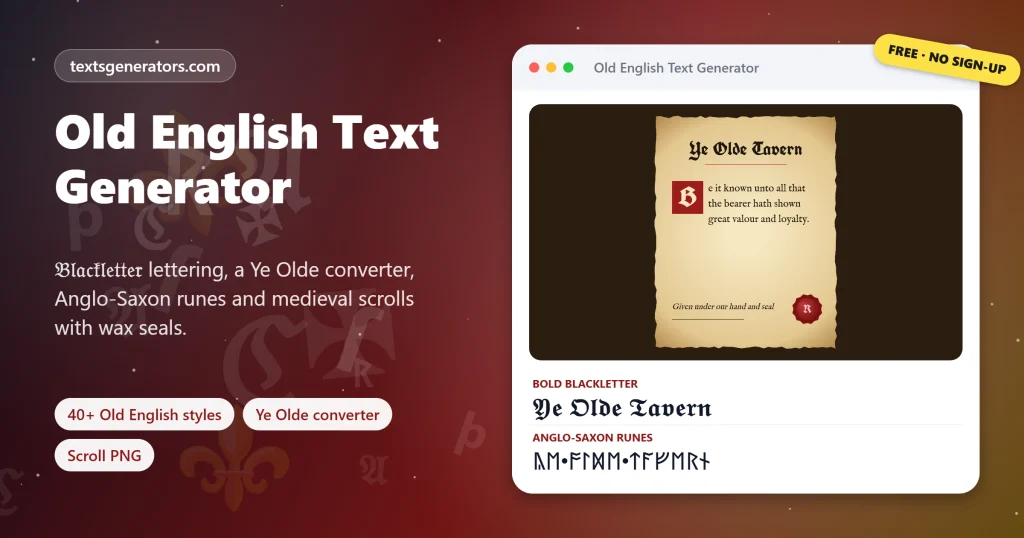
An Old English font like 𝔒𝔩𝔡 𝔈𝔫𝔤𝔩𝔦𝔰𝔥 suits tattoos, pub signs and certificates, and this page adds more: use the Old English translator to turn modern sentences into “Ye Olde” spelling with thou, hath and the long s, translate names into Anglo-Saxon runes, and produce a parchment proclamation crowned with your heading, a red drop cap and a wax seal.
- 40+ Old English styles
- Ye Olde spelling converter
- Futhorc rune translator
- Scroll PNG with wax seal
Your motto from the top box becomes the scroll title, lettered in one of six period faces.
All Old English styles
Planning a tattoo or a pub sign?
Share the Old English generator so your artist or partner can compare lettering.
Old English Lines for Tattoos, Signs, Fantasy and Family Names
Blackletter mottos, sign names and runic lines ready to paste. Copy takes the line as written; Edit in tool carries the words to the input for the converter and the scroll maker.
What Is an Old English Text Generator?
Quick answer: this kind of tool rewrites plain letters as medieval Fraktur characters like 𝔒𝔩𝔡 𝔈𝔫𝔤𝔩𝔦𝔰𝔥, the dark, angular lettering seen on tattoos, newspaper mastheads and certificates. The same page can rewrite modern English in “Ye Olde” style and translate names into Anglo-Saxon runes.
“Old English” means two different things. Linguists use it for the language of the Anglo-Saxons, spoken from about AD 450 to 1150. Everyone else uses it for blackletter type, the medieval script also called Gothic or Textura. This tool covers both meanings, which makes it far more than a font converter.
For the lettering, Unicode’s Fraktur alphabets give you regular and bold blackletter that paste into Instagram, X, Etsy, and gaming names. For playful period language, the Ye Olde converter swaps the for ye, you for thee or thou, has for hath, and adds olde-fashioned endings like shoppe and towne, with an optional long s. For the real Anglo-Saxon flavour, the rune translator spells words in the Futhorc alphabet, including the special runes for th, ng and ea.
To finish, a scroll maker sets your heading in one of six period typefaces on aged parchment, adds a red illuminated drop cap and stamps a wax seal with your initials, ideal for awards, party invitations, game props and social posts.
- 26 Ye Olde word swaps
- 30 Anglo-Saxon runes used
- 6 Period typefaces
How Do You Write in Old English Letters?
- Type a word, name or motto: Short phrases look strongest in blackletter.
- Copy a blackletter style: Regular, bold, initials only or framed with crosses, crowns and swords.
- Make it sound old: Run sentences through the Ye Olde converter or translate them into runes.
- Create a scroll: Download a parchment proclamation with drop cap and seal.
Old English Language Versus Old English Font
| Old English language | Old English (blackletter) font | |
| What it is | The earliest form of English | A medieval style of lettering |
| Period | About 450 to 1150 | About 1150 to 1500, revived ever since |
| Example | Hwæt! Wē Gār-Dena in geār-dagum | 𝔒𝔩𝔡 𝔈𝔫𝔤𝔩𝔦𝔰𝔥 |
| Alphabet | Latin letters plus þ, ð, æ, ƿ, and earlier runes | Latin letters with angular strokes |
| On this page | Rune translator and old letters | Blackletter styles and scroll maker |
Why “Ye Olde” Was Never Pronounced Ye
Medieval scribes wrote the sound th with the letter thorn, þ. Early printers imported their type from the Continent, where thorn did not exist, so they substituted a y that looked similar. “Ye” in “Ye Olde Shoppe” was therefore read as “the”. The extra e endings, like olde and shoppe, are a later, playful imitation of older spellings rather than true Old English.
Old English and Blackletter Terms
Blackletter
The heavy, angular script family used across medieval Europe.
Textura
The most formal blackletter, used in the Gutenberg Bible of about 1455.
Fraktur
A German blackletter with broken curves, used until the 1940s.
Thorn þ and eth ð
Old English letters for the th sounds, later replaced by th.
Long s (ſ)
The tall ſ that printers placed anywhere except a word’s final letter, abandoned around 1800.
Futhorc
The Anglo-Saxon runic alphabet, named after its first six runes.
For more blackletter variations, including royal and gangster looks, open the gothic font generator.
Popular Uses for Old English Lettering
- Tattoos: names, dates, and mottos in bold blackletter.
- Pubs, breweries and barbers: signs and labels with a heritage feel.
- Newspaper-style mastheads and certificates.
- Fantasy gaming and tabletop campaigns such as Dungeons and Dragons.
- Renaissance fairs and themed parties with olde-style invitations.
Old English Generator Features
40+ styles
Blackletter, Ye Olde, runes, and frames.
Ye Olde converter
Thou, hath, ye and olde spellings.
Rune translator
Futhorc with th, ng, ea and oe runes.
Scroll maker
Parchment, drop cap and wax seal.
Long s
Authentic 18th-century spelling.
Old letters
Thorn, wynn, ash and eth.
Medieval frames
Crosses, swords, crowns and shields.
Limits
Bio, name and Etsy title checks.
Favourites
Keep your tattoo shortlist.
Want a name in real runes?
Translate any name into the Anglo-Saxon Futhorc alphabet.
Tips for Authentic Old English Designs
1. Avoid all capitals
Blackletter capitals are ornate; a capital initial with lowercase reads better.
2. Mind tattoo spacing
Blackletter needs space between letters to heal cleanly.
3. Use red sparingly
Medieval scribes used red only for initials and headings.
4. Do not overdo olde words
One or two archaic words feel charming; ten feel like a parody.
5. Check rune meanings
Runes spell sounds, not translations; the language stays English.
6. Pair with a plain serif
Details in a quiet serif keep certificates readable.
Old English Text Issues and Fixes
| Problem | Why | Fix |
| Runes appear as boxes | The device lacks a Runic font | Most phones have one; on old PCs, install Segoe UI Historic or Noto Sans Runic |
| ℭ ℌ ℑ ℜ ℨ look different | Five capitals predate the Fraktur alphabet in Unicode | Use Bold Blackletter for a consistent look |
| The long s looks like an f | That is how it was printed | Turn the long s option off if it confuses readers |
| Ye Olde changed a word I wanted to keep | The swap list is automatic | Untick a group or edit the output |
| The scroll uses a plain serif | Google Fonts did not load | Reconnect and reopen the panel |
| The tattoo artist cannot read it | Unicode text varies by device | Send them the scroll PNG instead |
How This Old English Generator Compares
| Feature | This page | Typical Old English font pages |
| Blackletter styles | ✅ 40+ | ✅ One or two |
| Ye Olde language converter | ✅ | ❌ |
| Anglo-Saxon runes | ✅ | ❌ |
| Scroll with drop cap and seal | ✅ | ❌ |
| Language versus font explained | ✅ | Rarely |
Old English Translator: What It Changes and What It Cannot
Searches for an Old English translator usually mean one of three things, and they are not the same. Ye Olde English is the playful pub-sign spelling of later centuries. Middle English is the language of Chaucer, used from about 1100 to 1500. True Old English, or Anglo-Saxon, was spoken before 1100 and feels like a foreign language today. The translator here handles the first and gives names a genuine Anglo-Saxon look with runes.
| Search | What it means | What this page does |
| English to Old English | Old-fashioned spelling and words | Converts to thou, hath, -eth endings and the long s |
| Medieval translator | Middle English of the Chaucer era | Adds period flavour; full grammar is beyond automatic tools |
| Anglo-Saxon translator | English before 1100, with þ, ð and æ | Writes names in Anglo-Saxon runes and explains the lost letters |
| Elizabethan English | English of the 1500s and 1600s | Uses the thou and thee forms of that period |
Old English Font Copy and Paste for Tattoos and Signs
The Old English font most people picture is blackletter, the dense, angular lettering of medieval manuscripts and newspaper mastheads. Copy it in regular or bold weight, and test a full name before deciding: capitals such as 𝔄, 𝔊 and 𝔐 are ornate, and some readers confuse them at small sizes.
For a darker tattoo look, bold blackletter with plenty of space between words reads better than the regular weight squeezed into a small area.
Runes from other traditions, such as Elder Futhark, live on the fantasy font generator.
Old English Text: Questions Answered
What is Old English text?
Online, it usually means blackletter lettering, such as 𝔒𝔩𝔡 𝔈𝔫𝔤𝔩𝔦𝔰𝔥. Strictly, Old English is also the language of the Anglo-Saxons.
Is Old English font the same as Gothic font?
Yes, both names describe blackletter. Old English Text is also the name of a specific digital font based on it.
How do I write “Ye Olde” style?
Paste a sentence into the Ye Olde English Converter; it swaps words like the, you, and has for ye, thee, and hath.
Was “ye” pronounced ye?
No. Ye was a printer’s stand-in for thorn, þ, and was pronounced the.
What is the long s?
It is the tall ſ of Georgian-era books, which readers often mistake for an f.
Can I translate my name into runes?
Yes. Type it into the Anglo-Saxon Rune Translator to get Futhorc runes.
Are Anglo-Saxon runes the same as Viking runes?
They are related. The Anglo-Saxon Futhorc has extra runes, while Viking-age Norse used the shorter Younger Futhark.
Can I use Old English letters for a tattoo?
Yes. Compare styles, then download the scroll PNG or send the text to your artist.
Does Old English text work on Instagram?
Yes. Instagram profiles and posts show Fraktur letters properly on modern phones.
What letters did Old English have that we lost?
Thorn (þ), eth (ð), wynn (ƿ), and ash (æ) were part of the Old English alphabet.
Which period fonts are in the scroll maker?
UnifrakturCook, UnifrakturMaguntia, Pirata One, Grenze Gotisch, IM Fell English and MedievalSharp.
How do I make a medieval certificate?
Type the heading, open the Medieval Scroll Maker, edit the body text and seal initials, then download.
What does Hwæt mean?
It is the first word of the poem Beowulf, roughly meaning listen or so.
Why does ℭ or ℌ look unlike the other medieval capitals?
Five Fraktur capitals were encoded earlier in Letterlike Symbols, so fonts draw them separately.
Can I write thou and thee correctly?
Thou is the subject, thee the object, thy and thine the possessive. The converter applies common forms automatically.
When was blackletter used?
From the 12th century in manuscripts and in early printing, including Gutenberg’s Bible around 1455.
Can I use these styles in a Discord name?
Yes, within Discord’s 32-character nickname limit.
Is blackletter hard to read?
It is less legible in long passages, so use it for names, headings, and mottos.
Can I use the scroll image commercially?
Yes. The fonts are open-licensed, and the image is generated from your text.
Is my text saved anywhere?
No. Conversions, runes, and scrolls are produced in your browser.
Is this Old English generator free?
Yes. Every style and tool is free to use.
Can this translate English into real Old English?
Not word for word. Real Old English has its own grammar and vocabulary, so the translator gives a Ye Olde style and shows names in Anglo-Saxon runes. For a true translation, use an Old English dictionary or a scholarly glossary.
How is Old English different from Middle English?
Old English was used before about 1100 and looks foreign today; Middle English, used until about 1500, is the language of Chaucer and partly readable to modern eyes.
Is the Old English font free to copy and paste?
Yes. Every blackletter character belongs to the Unicode standard, which means no licence, no download, and no cost wherever it goes.
Write Like a Medieval Scribe
✠ 𝖄𝖊 𝕺𝖑𝖉𝖊 𝕰𝖓𝖌𝖑𝖎𝖘𝖍 ✠
Blackletter, olde spelling, runes and parchment scrolls, free.📜 Write in Old English
- 3D Text Generator
- Aesthetic Text Generator
- Arrow Text Generator
- Big Text Generator
- Birthday Text Generator
- Bold Italic Text Generator
- Bold Text Generator
- Bracket and Boxed Text Generator
- Bubble Text Generator
- Calligraphy Text Generator
- Christmas Text Generator
- Clap Emoji Text Generator
- Cool Fonts Generator
- Copy and Paste Fonts
- Cursive Generator: Cursive Letters and Fonts
- Cute Fonts Generator
- Decorative Text Generator
- Discord Fonts Generator
- Diwali Text Generator
- Double Struck Text Generator
- Eid Text Generator
- Emoji Text Generator
- Fancy Text Generator
- Flag Text Generator
- Glitch Text Generator: Zalgo and Cursed Text
- Glow Text Generator
- Gothic Text Generator
- Halloween Text Generator
- Heart Text Generator
- Invisible Text Generator
- Italic Text Generator
- LinkedIn Text Generator
- Love Text Generator
- Monospace Text Generator
- Neon Text Generator
- New Year Text Generator
- Serif And Sans Serif Text Generator
- Small Caps Generator
- Small Text Generator
- Square Text Generator
- Star Text Generator
- Strikethrough Text Generator
- Stylish Text Generator
- Subscript Text Generator
- Underline Text Generator
- Valentine’s Text Generator
- Vaporwave Text Generator
- Weird Text Generator
No tools match your search. Try another word or choose "All tools".